Agentic AI statistics and trends in 2026
What is Agentic AI?
Agentic AI refers to AI systems that do more than just simply generate content or answer prompts. They can plan, decide and act across multiple steps to complete a goal. This means an agent can use tools, pull data from business systems, hand work off between models or workflows and keep moving until a task is done, with of course humans supervising rather than actually doing every step manually. That is the shift that makes agentic AI so important in 2026! Businesses are moving from asking whether AI can help people work faster to asking whether AI can handle pieces of work on its own.
The market in 2026 is no longer just about chatbot excitement, it is about operational adoption, software integration, governance, ROI, etc. The numbers show momentum is real but so is the maturity gap. Companies are rolling out AI quickly yet the vast majority are still figuring out how to turn pilots into systems they can fully trust at scale.
1. AI adoption is already broad but maturity is still thin
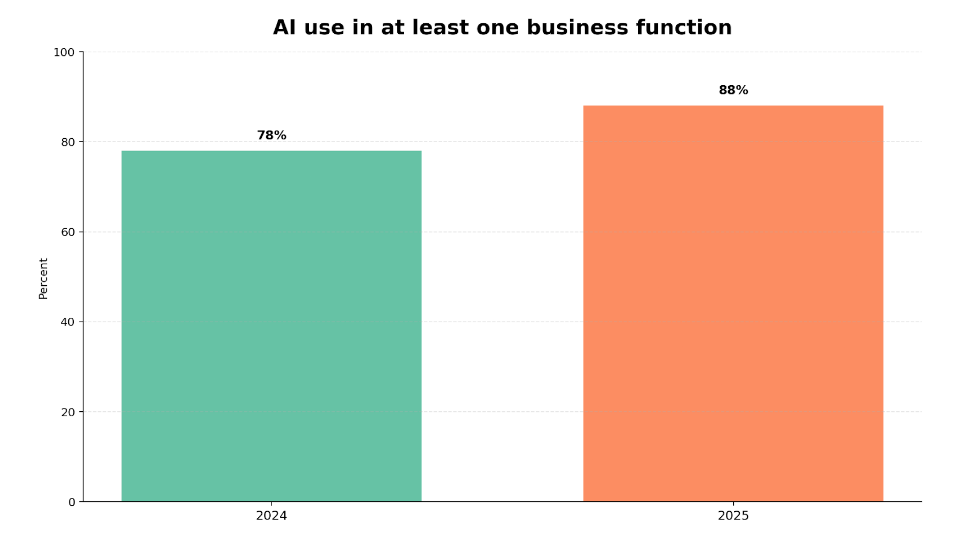
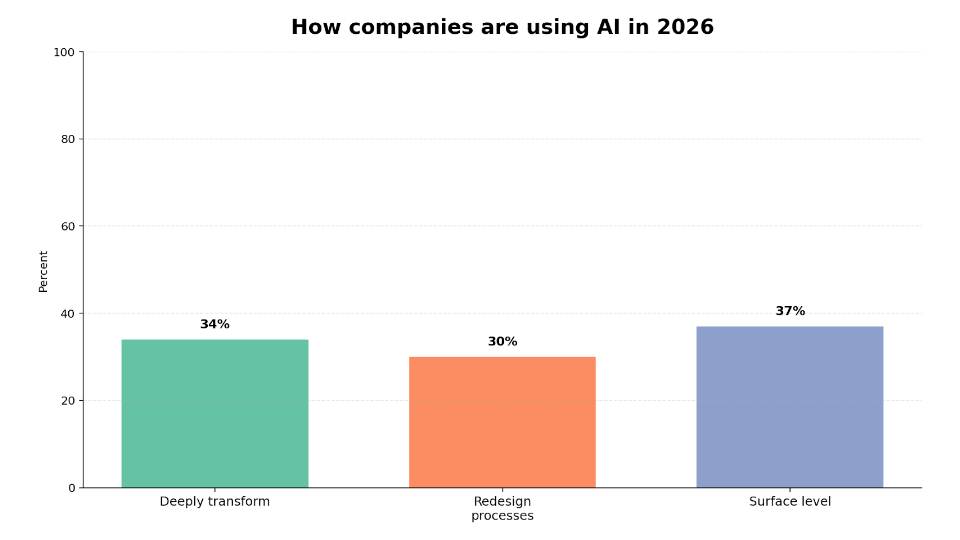
A good place to start is the wider AI backdrop. McKinsey found that 88% of organisations were using AI in at least one business function in 2025, up from 78% in 2024. That is a huge jump in one year. But broad adoption does not mean deep transformation. Deloitte’s 2026 research says only 34% of companies are deeply transforming the business with AI, while 30% are redesigning key processes and 37% are still using AI at a more surface level. AI is everywhere but meaningful reinvention is still the exception.
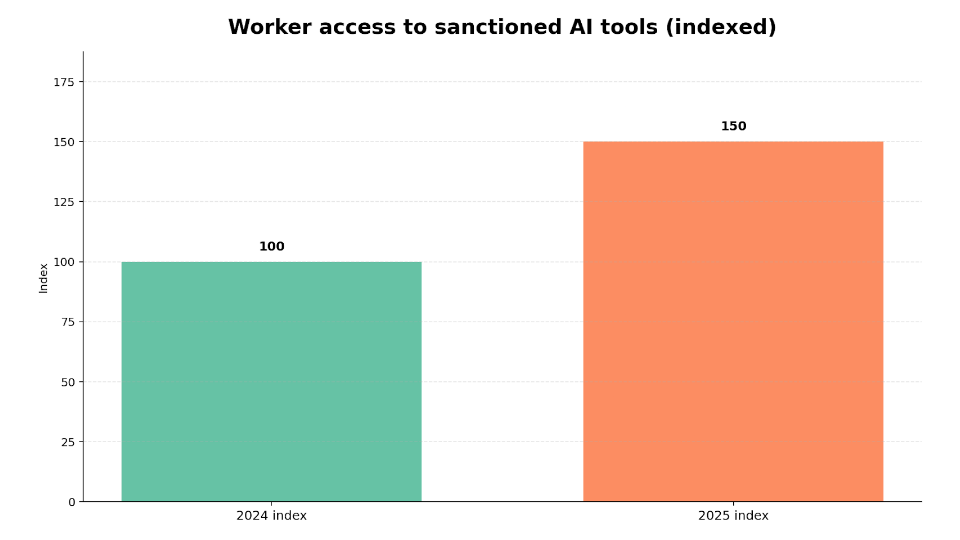
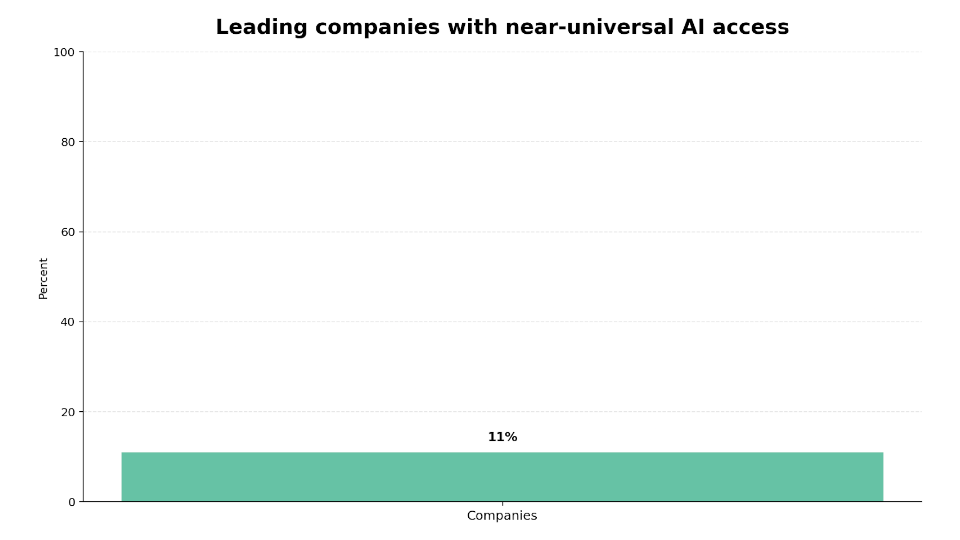
That same gap shows up in production readiness. Deloitte says worker access to AI rose by 50% in 2025, climbing from under 40% to around 60% of workers with sanctioned AI tools. Yet only 11% of leading companies provide near-universal access and among workers who do have access, fewer than 60% use AI in their daily workflow. So the story in 2026 is not simply access. It is adoption quality.
2. Agentic AI has clearly moved into the enterprise
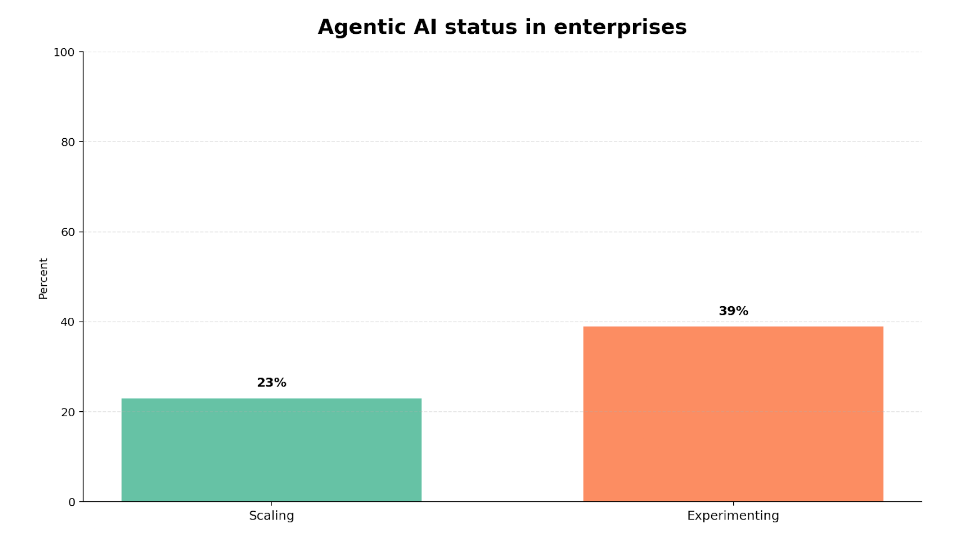
This is no longer a fringe category. McKinsey found that 23% of organisations are already scaling an agentic AI system somewhere in the business and another 39% are experimenting. This means well over half of surveyed organisations are at least testing the agentic model. But there is a catch! McKinsey also notes that in any individual business function, no more than 10% of respondents say they are scaling agents. So the rollout is real but still narrow.
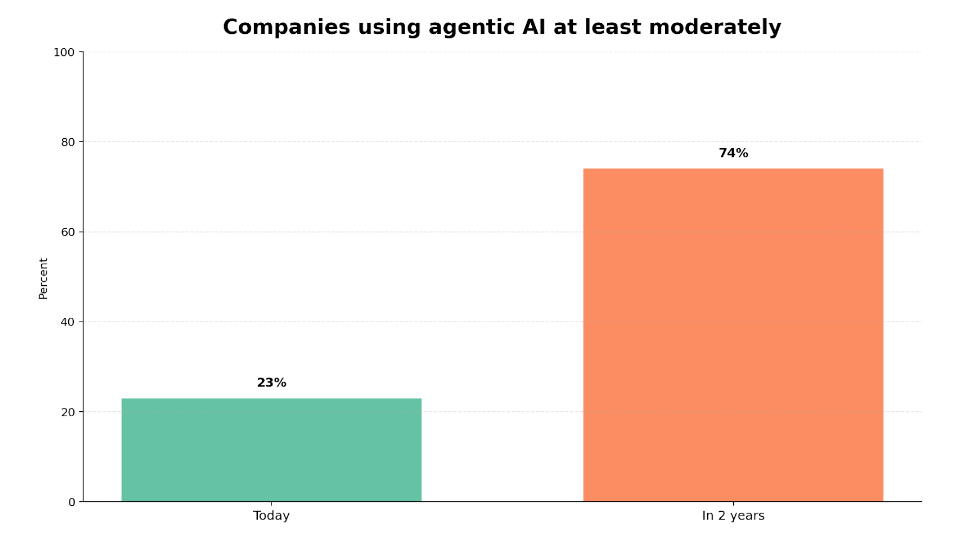
Deloitte’s 2026 report shows the same trend line from a different angle. It says 23% of companies are using agentic AI at least moderately today but within two years that figure is expected to hit 74%. 23% expect to use it extensively and 5% expect to make it a core part of operations. This suggests 2026 is the year agentic AI stops being an 'emerging idea' and becomes part of the mainstream enterprise roadmap.
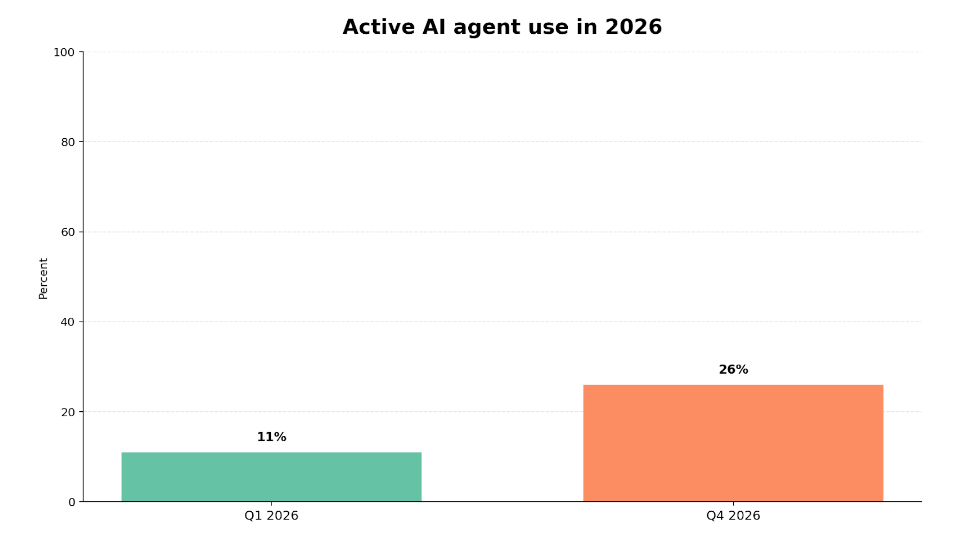
KPMG’s quarterly pulse data makes the shift even more obvious as it reports that active AI agent use rose from 11% of organisations in Q1 2026 to more than 26% by Q4. A rapid move from pilot activity toward mainstream deployment.
3. Leaders are pushing harder than organisations are prepared for
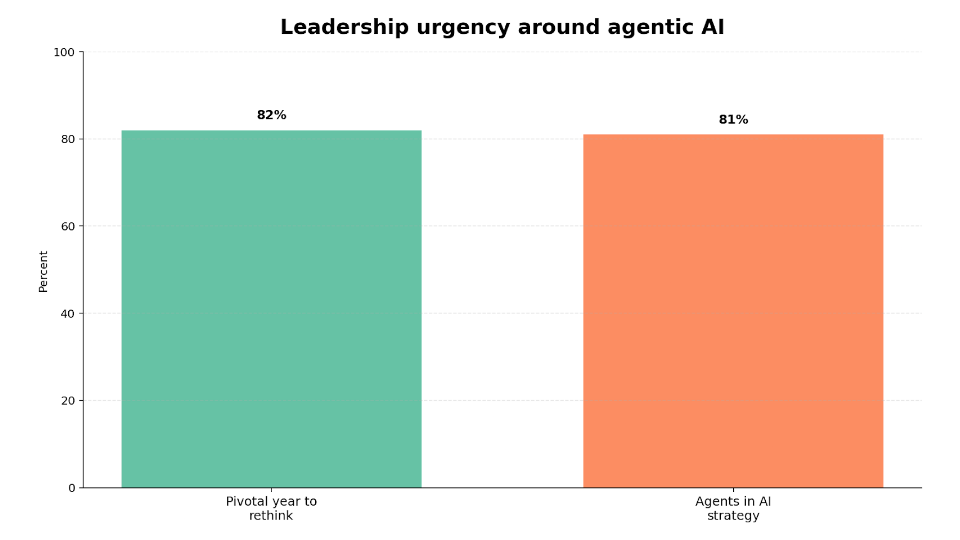
Microsoft’s Work Trend Index is one of the clearest signals when it comes to executive mood. It found that 82% of leaders say 2025 was a pivotal year to rethink strategy and operations and 81% expect agents to be moderately or extensively integrated into AI strategy within 12 to 18 months. That makes 2026 the first full year in which agentic AI is being treated as a strategic operating model issue, not just an innovation project.
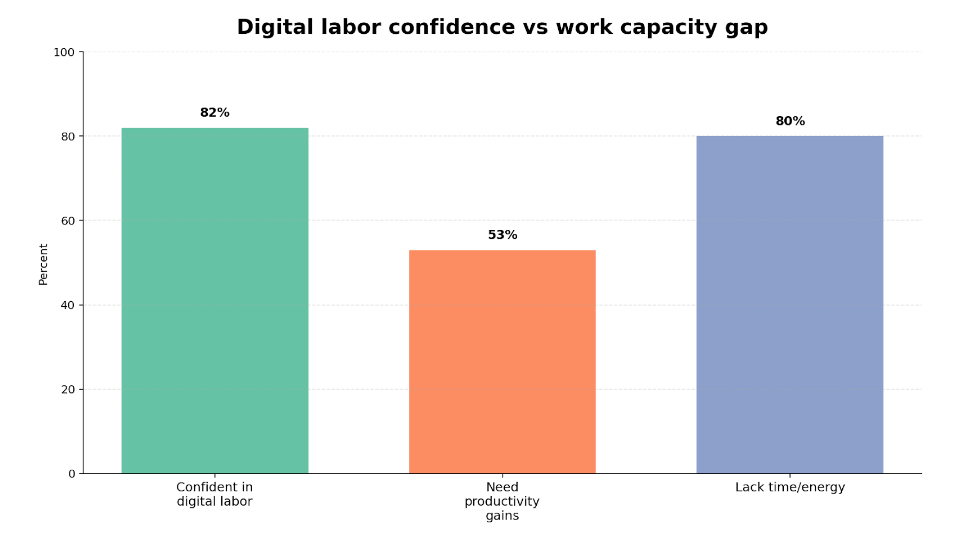
The same report shows why. 82% of leaders say they are confident they will use digital labour to expand workforce capacity in the next 12 to 18 months. At the same time 53% say productivity must increase and 80% of the global workforce says they lack enough time or energy to do their work. That is the opening agentic AI is stepping into... not just automation for its own sake but capacity relief in overstretched organisations.
Microsoft also found that 24% of leaders say their companies have already deployed AI organisation wide while only 12% remain in pilot mode. Agents tend to follow broader AI confidence so once companies feel comfortable with AI as infrastructure they become much more willing to let it act and not just assist.
4. The near-term value is still productivity first
For all the hype, the most common AI wins in 2026 are still practical. Deloitte says 66% of organisations report productivity and efficiency gains, 53% report better insights / decision-making and 40% report cost reduction. These are very strong numbers and reveal something important. The biggest measurable returns are still internal improvements not dramatic new revenue streams.
That becomes clearer when you look at revenue. Deloitte found 74% of organisations hope AI will help grow revenue but only 20% say it already is. So there is still a large expectation gap between what businesses want from AI and what they are currently getting from it. In 2026, agentic AI is best understood as a way to close that gap over time, starting with efficiency and moving toward business model impact later.
NVIDIA’s 2026 enterprise data tells a similar story on spending priorities. 42% of respondents said optimizing AI workflows and production cycles was the top spending priority for 2026, while 31% said finding additional use cases and another 31% said building or expanding AI infrastructure. That tells you where the market is now! It has become less 'Should we invest in AI?' and more 'How do we make the AI we already have actually work better?'
5. Enterprises are shifting from toy use cases to operating model change
UiPath’s 2026 report captures this shift neatly. It found that 78% of executives say they will need to reinvent their operating models to capture agentic AI’s full value. This is a critical trend since Agentic AI is not just another software layer, it fundamentally changes who does the work, how tasks are handed off and what humans are left to manage or supervise.
Deloitte reinforces this point with a more sobering stat: 84% of companies have not redesigned jobs around AI capabilities. Yet 36% expect at least 10% of their jobs to be fully automated within a year and 82% expect at least 10% of jobs to be fully automated within three years. So businesses are expecting automation to rise much faster than they are redesigning roles, workflows or org structures. That is a big risk area in 2026.
And while 53% of organisations have at least considered pod-based or non-hierarchical models, only 16% have moved to those models to a great or maximum extent. That suggests many leaders know traditional structures may not fit human-agent teams very well but most have not acted decisively yet.
6. The human side is becoming a serious differentiator
Another major 2026 trend is that agentic AI is no longer just a technology conversation. It is a workforce design conversation.
Deloitte says only 13% of non-technical workers are highly enthusiastic about AI. A further 21% would rather not use it but will if required and 4% actively distrust and avoid it. This means adoption friction is not just about systems integration. It is also about confidence, incentives and how work is being reshaped around people.
Most companies are reacting with education rather than redesign as Deloitte says 53% are mainly focusing on educating employees to raise AI fluency while fewer than half are making major talent strategy changes. Microsoft’s data adds another layer when it states 32% of managers are considering hiring AI agent specialists within 12 to 18 months and 28% are considering AI workforce managers to lead hybrid teams of people and agents. The implication is becoming clearer. New jobs are being created not just to build AI but to supervise and coordinate it.
7. Governance is becoming the make or break issue
Agentic AI is more valuable because it can act. That is exactly why governance matters more in 2026 than it did in the chatbot wave.
Deloitte says only 21% of companies currently have a mature model for governance of autonomous agents. At the same time, the top concerns around AI are governance-heavy. 73% cite data privacy and security, 50% cite legal, IP and regulatory compliance and 46% cite governance capability / oversight. The market wants agents but the guardrails are lagging.
UiPath’s 2026 report points in the same direction by elevating governance as code as a core requirement not a nice to have. And Deloitte notes that while 42% of companies believe their strategy is highly prepared for AI adoption only 30% say the same about risk and governance. This gap is one of the clearest warning signs of the whole 2026 dataset! Strategy confidence is quikcly outrunning operational control.
PwC’s AI Jobs Barometer adds a broader labour market signal after it analysed nearly a billion job ads across six continents to track how AI is changing skills, productivity and pay. In other words, the workforce effects are no longer anecdotal. They are large enough to be measurable at global labour-market scale.
8. Software is being rebuilt around agents
One of the most important trends for 2026 is that agentic AI is moving into the software layer itself.
Gartner predicts that 40% of enterprise applications will include task-specific AI agents by the end of 2026, up from less than 5% in 2025. That is a huge jump in a single year. It means agentic capability is moving from experimental add ons into mainstream business software.
Gartner goes a step further and says agentic AI could account for around 30% of enterprise application software revenue by 2035 rising from 2% in 2025 and surpassing $450 billion. This ultimately means that the software market increasingly expects value to shift from passive interfaces to systems that can execute work.
By 2029 AI agents are projected to generate 10 times more data from physical environments than all digital AI applications combined which suggests this agentic wave will not stop with office workflows and will indeed spill into robotics, logistics, industrial systems and real world operational environments.
9. Spend is following the trend hard
The money flowing into AI infrastructure and enterprise deployment is another reason 2026 feels like a turning point of a year.
Reuters reported on March 10, 2026 that Citigroup raised its global AI capex forecast for 2026 to 2030 to $8.9 trillion, up from its prior $8 trillion forecast. Citi also lifted its global AI revenue forecast for 2026 to 2030 to $3.3 trillion, up from $2.8 trillion. On top of this, hyperscalers including Amazon, Microsoft, Alphabet and Meta are expected to spend more than $630 billion in capital spending this year. This huge scale of investment matters because agentic AI needs infrastructure, orchestration, security and integration especially on the entreprise front.
10. 2026 is the year of pressure, not perfection
Put all of this together and the picture becomes pretty clear.
In 2026, agentic AI is not fully mature, fully trusted or fully embedded everywhere. But it is undeniably moving from promise to operating reality. The stats tell the story: 88% using AI somewhere, 23% already scaling agentic systems, 74% expecting moderate agentic use within two years, 40% of enterprise apps expected to contain task specific agents by the end of 2026 and only 21% with mature autonomous agent governance. This combination is what defines the market right now. Fast momentum, real value and real risk.
The smartest companies in 2026 will not be the ones that deploy the most agents for the sake of it! These will be the ones that identify high friction workflows, build around clear controls, redesign work and know where humans still need to stay in charge.
Sources
https://www.microsoft.com/en-us/worklab/work-trend-index/2025-the-year-the-frontier-firm-is-born
https://kpmg.com/us/en/articles/2025/ai-quarterly-pulse-survey.html
https://www.uipath.com/resources/automation-whitepapers/automation-trends-report
https://blogs.nvidia.com/blog/state-of-ai-report-2026/
https://www.pwc.com/gx/en/services/ai/ai-jobs-barometer.html